Subtotal:
$0


Drone Detection & C-UAS Solutions for the United States and Europe
Professional Drone Detection, Identification, Localization and Counter-UAS Technology
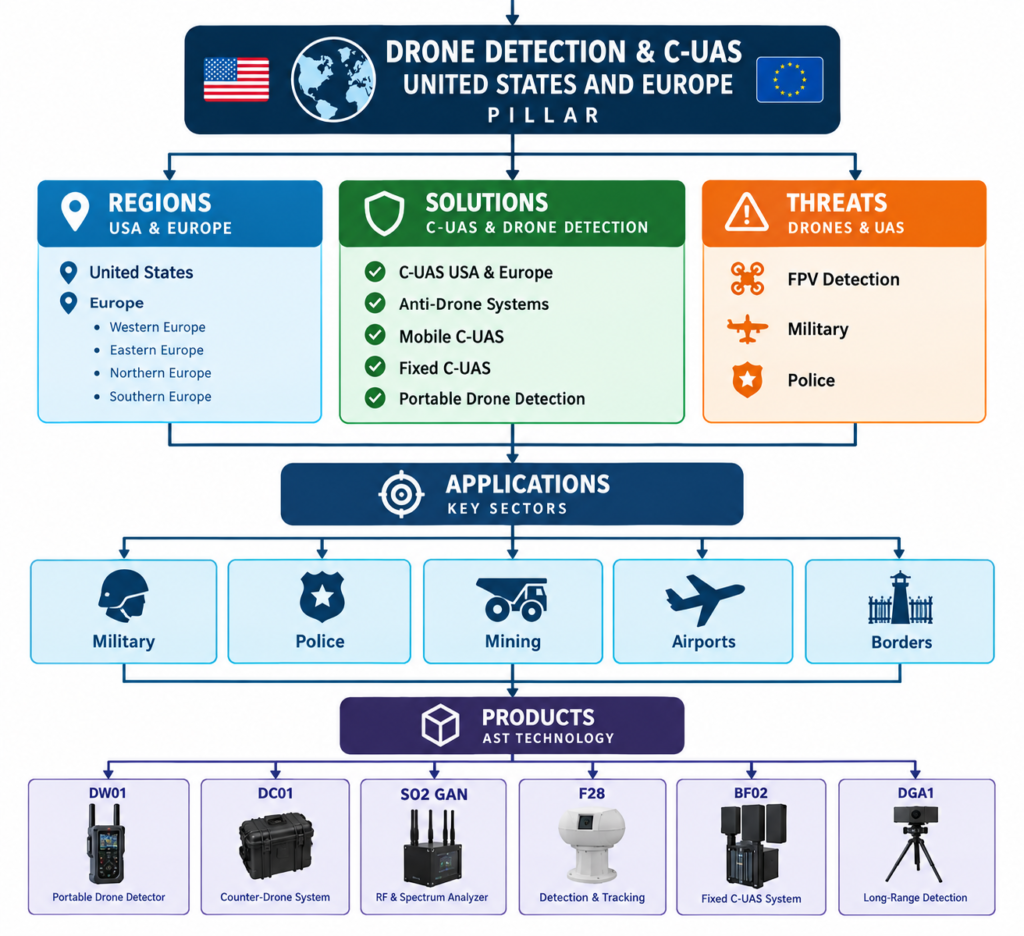
The relationship between drone detection → C-UAS → applications → regions → products.
The rapid growth of commercial, recreational, enterprise and tactical drone technology has created a new security challenge for organisations across the United States and Europe.
Unmanned aircraft systems (UAS), UAVs and FPV drones can provide significant operational benefits, but unauthorised or potentially hostile drone activity can also create serious risks for military installations, airports, critical infrastructure, ports, prisons, public venues, industrial sites, corporate facilities and other sensitive locations.
AeroSafeTech provides drone detection and Counter-UAS (C-UAS) solutions designed to help security, defence, law enforcement and critical infrastructure organisations understand what is happening in the airspace around them and develop an appropriate response.
Our approach goes beyond simply detecting that a drone is present.
Effective C-UAS protection should provide a structured capability to:
Detect → Identify → Locate → Assess → Respond
Depending on the operational requirement, this can involve RF detection, spectrum analysis, protocol-based identification, Remote ID and DroneID analysis, direction finding, drone and pilot localization, FPV detection, tracking, command-and-control integration and authorised countermeasures.
AeroSafeTech supports organisations looking to evaluate, deploy or expand professional drone detection systems and C-UAS technology across the USA and Europe.
Why Drone Detection Has Become a Security Priority
The drone threat landscape is changing quickly.
Modern drones are increasingly accessible, capable and difficult to manage using traditional security systems alone. Small UAVs can operate at low altitude, approach from unexpected directions and, depending on the platform and environment, present challenges for conventional surveillance systems.
For security teams, the first requirement is therefore visibility.
What drone is present? Where is it? Where did it come from? What is it doing? Is it authorised? And what response is appropriate?
A modern drone detection system can provide the information required to answer these questions and support a proportionate security response.
Government security guidance in the UK describes C-UAS capabilities around functions including detection, tracking, identification and, where required, an effect or countermeasure.
This makes drone detection an important component of a broader airspace security strategy rather than simply another standalone security sensor.
What Is a C-UAS System?
C-UAS means Counter-Uncrewed Aircraft Systems.
The term covers technologies, sensors, software and operational processes used to detect, identify, track, assess and potentially respond to unauthorised or threatening unmanned aircraft.
C-UAS systems are increasingly relevant outside traditional military environments.
Potential applications include:
- Military and defence facilities
- Police and law enforcement
- Border security
- Airports and aviation facilities
- Ports and maritime infrastructure
- Power generation and utilities
- Oil and gas facilities
- Data centres
- Prisons and correctional facilities
- Mining and industrial sites
- Government buildings
- Stadiums and major events
- Corporate and private security
- Critical national infrastructure
UK government guidance also identifies applications around critical infrastructure such as airports, power stations, ports and oil and gas facilities.
For organisations in the United States and Europe, the objective is not simply to purchase an “anti-drone system”. The objective should be to develop a measurable and appropriate counter-UAS capability for the specific site, threat environment and operational requirement.
The AeroSafeTech C-UAS Approach
AeroSafeTech approaches drone security as a layered technology problem.
No single sensor or detection method should automatically be assumed to provide the best answer for every environment.
Different drone types, frequencies, operating conditions, terrain, buildings, electromagnetic environments and site layouts can all influence system performance.
Our approach is therefore based around several complementary capabilities.
1. Drone Detection
The first stage is identifying the presence of a potential UAV within the protected airspace.
RF and spectrum-based technologies can monitor relevant portions of the radio-frequency environment and identify signals associated with drone activity.
Depending on the system, detection may involve monitoring frequencies used by commercial drone platforms, control links, video transmission or other relevant RF signatures.
Passive detection can also provide an important advantage where organisations want to monitor an environment without unnecessarily transmitting RF energy.
The correct detection technology depends on the threat, site and operational requirement.
2. Drone Identification
Detecting a signal is only the beginning.
Security personnel may need to determine what type of drone is present and, where supported, obtain additional information about the aircraft.
Modern detection technologies can analyse signals and protocols to assist with identifying supported drone platforms and distinguishing between different types of UAV activity.
Capabilities may include:
- Drone model identification
- DroneID analysis
- Remote ID analysis
- Protocol analysis
- RF signature analysis
- Signal classification
- Drone serial or identification information where supported
- Authorised/known-device lists
- Threat assessment information
This additional information can help security teams make better decisions about whether an alert represents a genuine security concern.
3. Drone and Pilot Localization
Detection without location information can leave security teams with an incomplete picture.
Depending on the system and operating environment, C-UAS technology can assist in determining the approximate location or direction of a drone and, where supported, the location of its controller or pilot.
Direction finding and protocol-based positioning can help transform a basic detection alert into actionable situational awareness.
For a security operation, the difference between:
“A drone has been detected.”
and
“A drone has been detected approaching this protected area from this direction.”
can be significant.
4. FPV Drone Detection
FPV drones represent a particular challenge for security organisations.
First-person-view systems can use different control and video-transmission architectures from many conventional consumer drones. This means a C-UAS strategy designed around only one class of commercial drone may not provide adequate coverage.
AeroSafeTech therefore includes FPV and analogue video detection within its broader C-UAS technology approach.
Dedicated FPV detection can complement conventional drone identification technologies and provide additional awareness of lower-cost, manually operated or non-standard UAV platforms.
For defence, law enforcement, critical infrastructure and high-security environments, considering FPV threats during system evaluation is increasingly important.
5. Counter-UAS Response
Detection and identification provide the information required to assess a threat.
In some environments, however, security teams may also require an authorised countermeasure capability.
Counter-UAS response technologies can include electronic or other effectors depending on the operational requirement and applicable laws.
AeroSafeTech provides counter-drone technologies that can be configured around different deployment requirements, including portable, mobile and fixed applications.
However, countermeasures must always be evaluated in the context of applicable federal, national, local, aviation, spectrum, safety and operational requirements.
The legal ability to use a particular countermeasure can vary significantly between jurisdictions and applications.
For this reason, AeroSafeTech recommends evaluating the complete operational requirement before selecting a C-UAS architecture.
Fixed, Mobile and Portable C-UAS Solutions
Different organisations have different security problems.
A permanent critical infrastructure facility may require continuous fixed-site monitoring.
A military or law-enforcement organisation may need mobile protection that can move between locations.
A security team protecting a VIP, event or temporary site may require portable detection.
A complete C-UAS strategy can therefore combine different system types.
Fixed C-UAS
Fixed systems are designed for established sites requiring continuous or semi-permanent monitoring.
Potential applications include:
- Military bases
- Airports
- Ports
- Energy infrastructure
- Industrial facilities
- Prisons
- Data centres
- Government facilities
- Critical infrastructure
Fixed systems can provide a foundation for persistent airspace awareness and can potentially be integrated with other security infrastructure.
Mobile C-UAS
Mobile C-UAS systems can provide a flexible security capability for organisations that operate across multiple locations.
Vehicle-mounted systems can be particularly relevant for:
- Military patrols
- Police operations
- Border security
- Convoy protection
- Temporary site security
- Critical infrastructure inspections
- Large outdoor events
Portable Drone Detection
Portable and handheld systems can provide security personnel with independent drone detection and situational-awareness capabilities.
AeroSafeTech’s existing product range includes portable, handheld and wearable drone detection technologies.
These solutions can complement larger fixed or mobile C-UAS systems rather than necessarily replacing them.
C-UAS for Defence and Military Applications
Military organisations face some of the most demanding drone-security environments.
The threat can range from commercially available UAVs to customised, FPV and other non-standard platforms.
A defence C-UAS architecture may therefore require multiple layers of detection and response rather than reliance on one technology.
AeroSafeTech can support evaluation of capabilities including:
- Long-range drone detection
- RF and spectrum monitoring
- Drone identification
- Remote ID and DroneID analysis
- Direction finding
- Pilot localization
- FPV detection
- Mobile C-UAS
- Fixed-site C-UAS
- Portable detection
- Countermeasure technologies
- Command and monitoring capabilities
The emphasis should be on building an architecture that matches the operational environment and threat profile.
C-UAS for Police and Law Enforcement
Law-enforcement organisations increasingly require technology that can provide rapid awareness of unauthorised drone activity around sensitive locations and operations.
Applications can include:
- Major events
- VIP protection
- Police operations
- Prisons
- Government facilities
- Emergency response
- Temporary security zones
- Critical incidents
For these applications, portability, speed of deployment, operator usability and reliable detection information can be as important as maximum detection range.
A C-UAS system should fit the way personnel actually operate.
Protecting Critical Infrastructure
Critical infrastructure operators cannot assume that conventional perimeter security provides complete protection from the air.
A drone may approach from outside the traditional security perimeter while still creating a potential security concern over the protected site.
C-UAS technology can provide an additional layer of airspace awareness around:
- Energy facilities
- Power stations
- Oil and gas installations
- Data centres
- Manufacturing facilities
- Water infrastructure
- Ports
- Airports
- Mining operations
- Telecommunications infrastructure
The UK National Protective Security Authority highlights the value of early warning, rapid response tasking, decision support and evidence collection when addressing hostile UAS risks.
For infrastructure operators, the goal is therefore not simply to detect drones, but to integrate drone awareness into the wider security process.
Drone Detection for Airports, Ports and Industrial Sites
Airports and other aviation-sensitive locations require careful consideration of drone activity because unauthorised UAV operations can create safety and operational concerns.
Ports, industrial facilities and large outdoor sites also present unique challenges because buildings, cranes, machinery, electromagnetic interference and complex terrain can influence detection performance.
This is why C-UAS selection should be based on real-world site assessment and testing, not simply a headline detection range.
Factors that should be evaluated include:
- Protected area
- Required detection range
- Terrain and buildings
- Electromagnetic environment
- Drone types
- FPV threat
- Required identification capability
- Number of simultaneous targets
- Fixed or mobile deployment
- Weather conditions
- Power availability
- Networking requirements
- Integration requirements
- Operator workload
- Legal and regulatory constraints
Choosing the Right Drone Detection System
There is no universal C-UAS system that is automatically right for every organisation.
A professional procurement process should begin with the security requirement rather than the product.
Key questions include:
What area needs protection?
A small high-security site and a large industrial facility may require completely different architectures.
What drone threats need to be detected?
Commercial DJI-type platforms, Remote ID-enabled aircraft, FPV systems, Wi-Fi drones and non-standard UAVs can present different detection challenges.
Is identification required?
Some organisations need only an alert, while others require information about the drone, signal, model, location or pilot.
Is FPV detection required?
If FPV or analogue video transmission is part of the threat model, this capability should be evaluated separately.
Does the organisation require a countermeasure?
Detection and identification may be sufficient for some applications. Others may require an authorised response capability.
Is the system fixed, mobile or portable?
Deployment requirements should influence the architecture from the beginning.
Can the system operate in the real environment?
Laboratory specifications are useful, but real-world testing is essential.
Pilot Testing and C-UAS Evaluation
For many organisations, the best approach is to conduct a structured pilot before committing to a larger deployment.
A pilot can help establish how the selected technology performs in the actual electromagnetic, geographic and operational environment.
A typical evaluation can examine:
- Detection performance
- Identification capability
- FPV detection
- Direction finding
- Drone localization
- Pilot localization
- False-alert behaviour
- Coverage
- Operator workflow
- System endurance
- Networking
- Data recording
- Environmental performance
- Integration requirements
- Countermeasure suitability where legally authorised
AeroSafeTech can work with customers to define the required configuration around the protected area, expected detection range, operating environment and required analysis capabilities.
This approach helps organisations move from a theoretical specification to an evidence-based C-UAS deployment strategy.
AeroSafeTech Drone Detection & C-UAS Technology
AeroSafeTech is a specialist supplier of counter-drone and drone detection technology, with products covering portable, wearable, handheld and broader counter-UAS applications.
Our technology portfolio is designed to support different operational requirements, from individual personnel requiring portable detection through to organisations evaluating fixed and integrated C-UAS protection.
The AeroSafeTech approach focuses on combining appropriate technologies rather than assuming one product can solve every drone-security problem.
Depending on the requirement, a solution may incorporate:
Detection
RF sensing, spectrum analysis and other appropriate detection technologies.
Identification
Drone and signal identification, including supported protocol, Remote ID and DroneID capabilities.
Localization
Direction finding and positioning capabilities where supported.
FPV Detection
Detection and analysis of relevant FPV and analogue video transmissions.
Tracking and Situational Awareness
Monitoring and visualisation of detected drone activity.
Counter-UAS
Authorised countermeasure technologies appropriate to the operational environment.
Deployment
Fixed, vehicle-mounted, portable, handheld and wearable configurations.
Drone Detection and C-UAS Across the USA and Europe
AeroSafeTech supports organisations evaluating drone detection and C-UAS requirements across the United States and Europe.
The company maintains a US presence as well as UK/European operations, supporting customers looking for professional anti-drone and counter-UAS technology.
For international organisations, the objective is to develop a solution that can be evaluated against the specific requirements of each site and jurisdiction.
This is particularly important for countermeasure technologies, where the regulatory environment and permitted use can vary between countries and operational contexts.
AeroSafeTech therefore recommends that customers consider legal and regulatory requirements as part of the system-selection process from the beginning.
Building a Layered C-UAS Capability
The most effective C-UAS strategy is rarely about buying the biggest system or selecting the product with the longest advertised detection range.
It is about creating the right combination of technologies for the actual threat.
For example, an organisation may require:
Fixed C-UAS
for persistent protection of a critical site.
Mobile C-UAS
for vehicle-based patrols and flexible deployment.
Portable detection
for security teams operating independently.
FPV detection
for identifying additional classes of drone threats.
Identification and localization
for understanding where the drone and, where supported, its operator may be located.
Countermeasures
where an authorised response capability is required.
This layered approach allows organisations to build C-UAS capabilities around operational requirements rather than relying on a single technology.
Why Choose AeroSafeTech?
AeroSafeTech positions itself as a specialist counter-drone technology supplier with a focus on drone detection, protection and C-UAS solutions. Its current portfolio includes portable, wearable and handheld detection technologies alongside broader counter-drone systems.
For B2B customers, the focus is not simply on supplying equipment.
The objective is to help organisations understand:
- What they need to detect
- Which drone threats matter to them
- What information operators need
- How much area requires protection
- Whether fixed or mobile deployment is appropriate
- Whether FPV detection is required
- Whether identification and localization are necessary
- Whether countermeasures are legally and operationally appropriate
- How the system can be evaluated before wider deployment
The result is a more structured approach to drone detection and Counter-UAS procurement.
Start Your Drone Detection & C-UAS Assessment
Every protected environment is different.
Before selecting a drone detection or C-UAS system, it is important to understand the protected area, expected threat types, required detection distance, operating environment and desired response capability.
AeroSafeTech can help organisations evaluate these requirements and identify an appropriate technology architecture for their application.
Whether you are protecting a military installation, airport, prison, port, energy facility, industrial site, government facility, event or critical infrastructure asset, the first step is understanding the airspace around your operation.
Discuss your drone detection and C-UAS requirements with AeroSafeTech.
Request a C-UAS assessment, discuss a pilot deployment, or request technical information about available drone detection and counter-UAS technologies for the United States and European markets.
Frequently Asked Questions
What is drone detection?
Drone detection is the process of identifying the presence of an unmanned aircraft within a monitored area. Depending on the technology, detection can use RF sensing, spectrum analysis, protocol analysis, radar, optical systems or combinations of different sensors.
What does C-UAS mean?
C-UAS stands for Counter-Uncrewed Aircraft Systems. It refers to technologies and operational capabilities used to detect, identify, track, assess and, where authorised, respond to unauthorised or threatening drones.
What is the difference between drone detection and C-UAS?
Drone detection focuses primarily on finding and identifying drone activity. C-UAS is a broader concept that can include detection, tracking, identification, localization, command and control, threat assessment and authorised countermeasures.
Can C-UAS systems detect FPV drones?
Some C-UAS technologies are designed to detect FPV and analogue video transmissions. However, performance depends on the drone, transmission system, environment and detection technology being used.
Are drone jammers legal in the USA and Europe?
The legality of RF jamming and other countermeasures varies according to jurisdiction, authority, location and application. Organisations should obtain appropriate legal and regulatory advice and confirm authorisation requirements before deploying or operating countermeasure technologies.
Do I need a fixed or mobile C-UAS system?
That depends on the operational requirement. Fixed systems can be suitable for permanent sites, while mobile systems can support patrols, temporary deployments and multiple locations. Many organisations can benefit from a layered combination.
How far can a drone detection system detect a drone?
Detection range varies substantially according to the technology, drone, transmitter power, antenna configuration, terrain, line of sight, electromagnetic environment and other factors. A published maximum range should therefore not be treated as a guaranteed operational range.
Can a drone detection system locate the pilot?
Some technologies can provide pilot or controller localization where the relevant signal or protocol can be detected and analysed. The capability varies by drone, technology and environment.
How should an organisation test a C-UAS system?
A structured pilot in the intended operating environment is often the most useful approach. Testing should evaluate detection, identification, localization, FPV capability, false alerts, coverage, operator workflow and other requirements relevant to the site.
Does AeroSafeTech provide C-UAS solutions in the USA and Europe?
AeroSafeTech markets counter-drone and drone detection technologies internationally and maintains US and UK/European operations. The appropriate system should be selected according to the customer’s operational, technical, environmental and regulatory requirements.